Paul Monaghan – Co-Founder, Allford Hall Monaghan Morris
Allford Hall Monaghan Morris is a global practice of over 400 highly skilled staff, bringing renowned design leadership to all its projects. Before we share our recent audience with co-founder Paul Monaghan, we’d like to congratulate the studio on being shortlisted for the RIBA London Award, with no less than three of its projects, including the major mixed-use Brentford Project (with landscape design by fellow Tenderstream members Grant Associates). From the transformation of the BBC studios at White City in London, to the design of New Scotland Yard, and then the Stirling Prize-winning Burntwood School (not to mention Paul’s early days playing piano in a band), you are most definitely in for a compelling read…
Hello Paul,
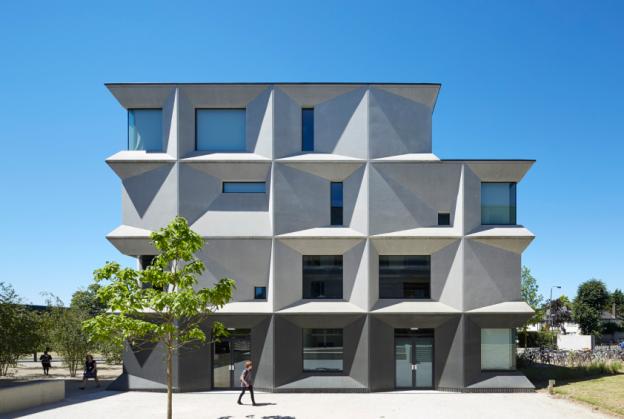
AHMM’s key projects in the workplace, arts, education, residential, and masterplanning sectors have all been recognised with numerous national and international awards, including the 2015 RIBA Stirling Prize for Burntwood School. So, let’s start with this project in south west London, with its striking geometric design. What, to you, makes Burntwood so special?
Burntwood is one of our most important projects. I think it had a number of things going for it. Number one, it was a state school done on a normal budget, and it was important to us that a building of quality could be delivered on such a budget, and that it was an exemplar that could be repeated. Number two was that the school's leadership team was phenomenal. There are 2,000 girls at the school, so it's huge, led by effectively just three people who were just incredible, not only in the way they developed the brief and design generation with us, but also in the way they ran a school with such passion.
As you say, while the architecture has this geometric form and is unusual, it actually came out of a really pragmatic study of how you build a school on a site when the school has to remain in operation for the entire five-year build. We almost designed it through the construction program. Next, we asked ourselves, “How do we make that not look random? How do we make it look like it was always meant to be like that?” And that's when the design concept comes in.
There's exceptionally good landscape design by Lynn Kinnear, which helps set the pavilions in the grounds. We also worked with a graphic artist, Morag Myerscough, to create what I suppose you might call the school's branding, as well as the signage, artwork, and furniture, which made it much more specific to Burntwood itself. So, I think it's all of those elements [that contribute to the project’s success]. Plus, I think when the Stirling Prize jury came round, it was an incredibly sunny day, and the building looked brilliant!
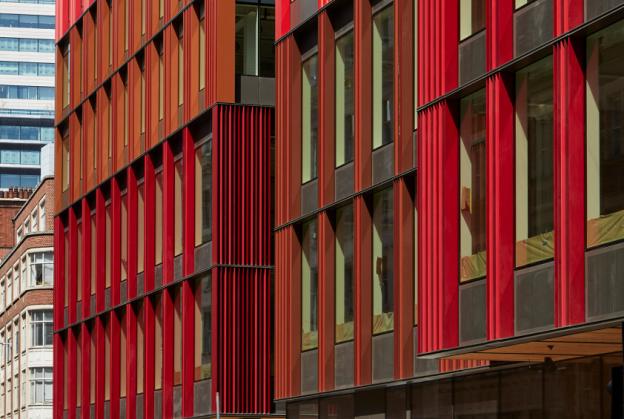
Moving to a completely different sector, AHMM’s 1 Broadgate project opened to the public in November 2025. Situated on the Broadgate campus in the City of London, this landmark commercial development offers 50,000 sq ft of retail space arranged over two circular levels, and 500,000 sq ft of new office space rising above in colours that reflect the earthy, autumnal tones of the City’s vernacular. How has the project been received by both the developer and its users since its completion? And how well do you feel it sits within its dense urban setting?
Number 1 Broadgate is a really important project for the practice. The clients are British Land and GIC, who own Broadgate. There was an existing 1980s building on site, but there were no cafes or restaurants around it. It was very closed to the public, and what British Land wanted was a building that was the opposite of that, with lively streets around the edge. The hard part was connecting it to Liverpool Street station via the shopping arcade that was already there. So, the simple solution was to drive an arcade through the new building in an L shape.
It’s a dynamic looking building. I think there are about 87 different colours on the outside of the building. The fact is, it’s a public building, so we didn't want it to be an anonymous office building. This really came out of working with the city planners, because the head of planning, Gwen Richards, wanted it to be different. So, the idea that it would have colour, which is very different for the City, was something that he felt strongly about.
British Land is very happy because the buildings are almost fully let, which is always a sign of a building's success. I think it's opened up Broadgate - there are far more people walking through it now.
In complete contrast, please share a little about the wonderful Alder Centre: its purpose and how AHMM has met its sensitive requirements.
The Alder Centre was an important project for me. It's part of Alder Hey Children's Hospital, the largest hospital in the north. It's like the ‘Great Ormond Street of the North’. Interestingly, it’s on the road where I was brought up. They held a competition, which I was naturally very keen to win, and among all the architects, I was the only one who said I grew up on the site and knew it well.
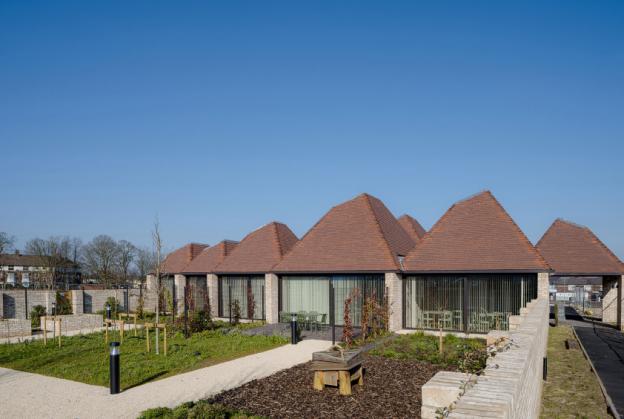
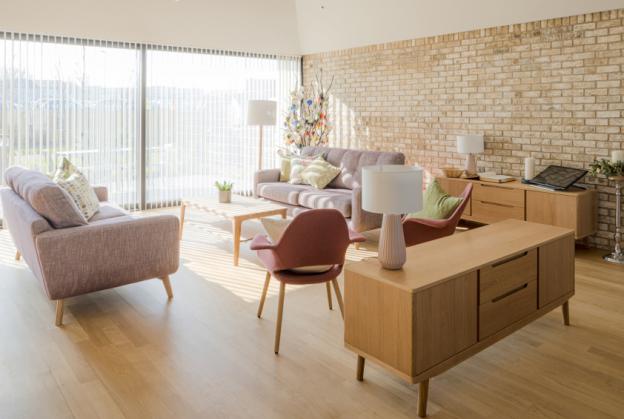
I think the second important thing was the idea of what the building is used for. It's for people who have lost a child, from babies to teenagers. Strangely, the Alder Centre was the only one in the country that had a counselling service for people in that situation. But the building they were in was in a converted bit of the hospital, so it was sort of okay, but not very relaxing. And what we wanted to create was this oasis in the hospital grounds.
We took the narrative of the book ‘The Secret Garden’, about a father who lost his wife and sank into deep depression, and his grandson, who tended the garden that had become overgrown, and made the garden a metaphor for healing his feelings of loss. We thought that was a really good concept, so now when you’re in the building, you're always looking out onto this private walled garden. The consulting rooms all have a view of the garden, which helps to provide a sense of privacy. People never recover from losing a child, but everybody who works in the building has lost a child, so they have great empathy with the clients.
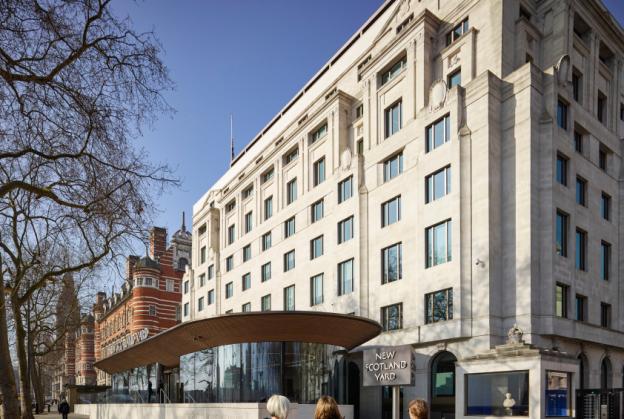
At the end of 2017, AHMM’s New Scotland Yard was awarded the Prime Minister’s Better Public Building Award, which, each year, recognises and encourages excellence in publicly funded buildings and infrastructure. How have you met the evolving needs of the Metropolitan Police Service and the public, but still managed to marry Curtis Green’s ‘Old Scotland Yard’ with the new one?
Well, that was an amazing commission too, because you could go anywhere in the world, and they'd know what Scotland Yard is. As an architect, you don't get commissions like that every day, so we were very proud to win it.
It was Sir Bernard Hogan Howe who was the head of the Metropolitan Police, and he was very clear that he wanted the building to be literally transparent so that the Met would be an open place, a place that was not a fortress, because the old Scotland Yard was like that. So that's why we came up with this glazed pavilion that was the big entrance lobby where people would wait to go into the building, and then you go into the old building that we refurbished, and that was the key idea. And, of course, it goes without saying that it couldn't be ordinary glazing because of issues one might need to consider.
And the second thing with Sir Bernard was that he wanted everyone to work in an open-plan environment, so that no one had an office. They have a great restaurant in the middle and a museum at the bottom, which the public can visit by appointment. It’s called the Black Museum and houses quite creepy historic ‘Jack the Ripper type’ things.
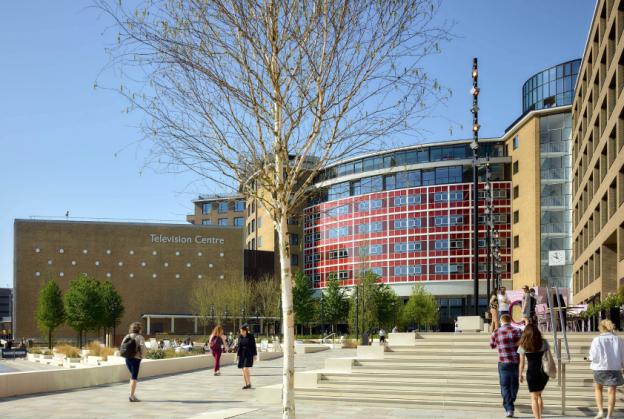
Masterplanning is one of your specialisations, so transforming the former BBC Television Centre in White City, London, must have been a rather enjoyable challenge! Can you tell us about the different mixed-use elements of the present scheme, and how some of the nostalgic ‘show-biz’ feel has been retained?
It's interesting that building isn't it? Because for all of us who are slightly older, we remember that building being on television all the time, Blue Peter, and things like the famous tap dancing with Roy Castle in the circle in the middle. I suppose our aim was to preserve the building's heritage elements. These are parts of the building that provide a collective memory for people, and we literally just refurbished those elements. But we also added new buildings around the edges, so the building’s setting wasn’t disturbed.
The key thing really was that there used to be security gates, and past those it was all car parking and taxis in front of the main building, whereas now the public can walk all the way through. It was quite a set of buildings. The BBC wanted to keep three studios, so we refurbished those. We knocked down five others, and this new setup is incredibly successful - they have the Pointless show, Good Morning Britain, Loose Women, and This Morning live every day. And they shoot outside too.
There are about 450 apartments, and the old lobby, which used to be called the Stage Door and was very grand, is now the super-lobby for all of them. There’s a big office building with lots of different companies, and there are also restaurants on the ground floor and a cinema. And then there's a Soho House club - a private club - which has a swimming pool on the roof. It really is totally mixed-use. And it's always lively, because there's often an audience arriving for a TV show.
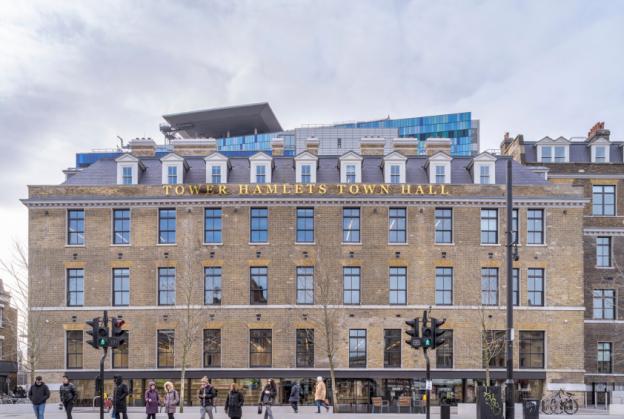
The magnificent Georgian facades of the former Grade II listed Royal London Hospital building in Whitechapel now envelope the new headquarters of the London Borough of Tower Hamlets. What prompted the move to this building, and how have services improved since its construction? What was the rationale behind its interior spaces?
The new Town Hall was formerly the Royal London Hospital in Whitechapel. They built a new hospital about 15 years ago, and the council bought the former hospital and wanted to convert it into a town hall. The old hospital has an amazing history. There's Edith Cavell, one of the first people to develop modern nursing, and many people know that John Merrick, the ‘Elephant Man’, lived there towards the end of his life. What's amazing is that so many people in that area were born there or went there for an operation, so people have this collective memory that it was special to them, perhaps even saved their life, and so our key objective there was, “how do we build all this new office space for the council, while maintaining the character of the building itself?”
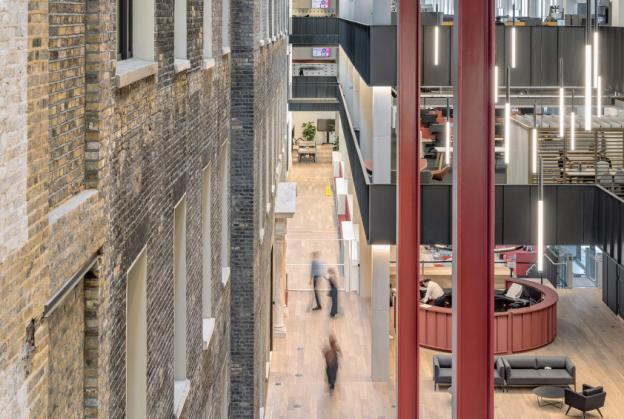
And our idea was to keep the front buildings on the High Street exactly the same, while refurbishing them as best we could. And on the rear, we created a new building, and in that gap, created an atrium that exposes the historic rear elevation. There are all sorts of plaques and ephemera from the hospital, which we kept so people can still come in to see them again. For a town hall, it’s great that people don't feel intimidated and feel a sense of belonging.
You were a member of the government’s Office for Place Advisory Board working with the Ministry for Housing, Communities and Local Government. In May 2022, you were appointed by the Mayor of London as one of the Mayor’s Design Advocates (MDAs). More recently, you were appointed Town Architect for Croydon, and since 2015, you’ve been the Liverpool City Region Design Champion, working with Mayor Steve Rotherham. How important do you feel it is for architects to have a voice and influence in the political arena? Do you think the government and local authorities should involve architects more? Could architects do more to get involved?
Yes, I think it's really important that architects try to use their experience, their skill set, to influence government, local government, national government. I think it's vital, because if you take something like the housing crisis, it's something that architects, albeit not alone, can resolve, or can design, and can design efficiently, or whatever the aspirations are.
I think a lot of the work I did when I was part of the Office for Place Advisory Board was about designing places, rather than just housing schemes or housing estates. It was about the importance of street design. For example, how cars can be integrated without taking over urban greening like trees. And then we gave an awful lot of guidance on the buildings themselves and the arrangement of those buildings.
More recently, I have become the Town Architect for Croydon, and I think what Jules Pipe, the Deputy Mayor of London, has done in driving these pilot projects - there are 12 town architects across London boroughs - has been a really pioneering program. In fact, I personally believe every big city should have a city architect.
My role in Liverpool is more about promoting the young, talented architecture firms in the city and the established firms, and encouraging people to use them on projects within the city.
On a more personal level, why did you choose to become an architect? Did you ever have any other career ambitions?
I think I wanted to be a journalist when I was really young. Then realised no one liked them! I did want to be a rock star, but I couldn't play the guitar. However, I could play the piano, and I was in a few bands, but it was fleeting. My dad was a draftsman working for English Electric, so the house was full of drawing equipment, and I was quite good at art at school. I went to a careers evening on architecture when I was 14, and I realised you could earn money through drawing. And I thought, well, that sounds good. It was literally as random as that.
I knew very little about architecture when I joined the University of Sheffield in my first year. I was lucky that I really, really loved it straight away. I wasn't bad at it, and I worked really hard with it. I enjoyed drawing anyway, but I really enjoyed the process. You know what it's like when you're young; you go, okay, I'll be an architect. You don't even think about the consequences, didn't think about how much money you might earn, didn't think about how long it would take to study.
I was in a good school in Liverpool. It was St Edwards College, a Catholic Grammar School, and all the cleverest kids in Liverpool went there, and I somehow got in. I was always average or on the lower end of the class. And when I went into architecture for the first time, I was more at the top end. And then as I got older, even more of the top end.
What would an ideal (if rare) work-free weekend entail for you?
I enjoy cycling. I'm not a heroic cycler, but I enjoy it. I find it very therapeutic. And the good thing with cycling is, if you do it in London, you can go down streets you’ve never been down. Always fascinating to learn different routes. I have always played tennis since I was a young boy and continue to try and perfect my forehand! I also play the piano, and our dinner parties at home often end with everyone singing around the keyboard.
And finally, AHMM has been a valued and long-standing member of Tenderstream since 2009. What is it that makes our service valuable to your team?
Before Tenderstream existed, we'd look in publications like the Architects’ Journal [for leads], but there was nothing very comprehensive. There were people offering services, but it never felt quite right for us. And then in 2009, we joined Tenderstream. Obviously, we'd had the 2008 crash, and we started to think might need to look not just in the UK but abroad too. And that's the service you were offering. And really, it was just about not missing these leads, whether it be a framework or a competition. I think it was invaluable to us, because without it we'd have had to employ our own researchers to investigate these countries.
Also, the way your website works makes it really easy to navigate. When you're less busy, when you're getting worried, you look more. And then when you are busy, you can maybe be a bit pickier about the ones you want; you could look at the size of the project or how interesting it is. Your service accommodates all those different elements, so I think that's why we've been members for 17 years.
Thank you.
Interview by Gail Taylor, Features Editor
IMAGE CREDITS
All images copyright AHMM
1. Burntwood School
2. 1 Broadgate
3/4. Alder Centre
5. New Scotland Yard
6. BBC Television Centre
7/8. Tower Hamlets